quartz

Story by Joe Gorin (USA).

Updating the TR7/8 clock to quartz accuracy.

Featured in WWWedge Ezine (october 1998)

Moderator: I have included the scans of the document Joe Gorin provided me with. Due to complexity of drawings, etc. I thought it would become handy for the ones who wants to this very technical job.

Here in the '90s, it seems silly to have an analog clock in your car, especially one as inaccurate and failure prone as that in the wedge. I have found that my failures were due to binding of the setting cable, and that this problem could be fixed by fatiguing the spring that pushes the setting knob out; when the spring exerts more force, the setting cable doesn't bind the clock.

Fred Smith explained in a TR8CCA newsletter how to adjust the clock for greater accuracy, and I later explained the "calibration factor" to do so. If one is very careful, the clock can be set to an accuracy of about a quarter-second per hour, about a minute per week.

Late model TR7/8s are supposed to have push-button reset trip odometers and quartz clocks.  Quartz clocks are listed by some suppliers for the same outrageous price as the listing for analog replacement clocks, over $100 US.  I think they require a hole in the plastic transparent panel that covers the instruments.  Woody Cooper tells me he has never seen this clock on a US car; I have been unable to find one in a junkyard.

I thought that it would be easy and fun to "graft" a $2 stick-on clock module into the analog clock, and get quartz accuracy.  Gary Knutson (I may have misspelled his name) was kind enough to give me his old clock for experimentation purposes.

It was not easy, but it was educational, and thus fun.  I finally got a circuit running using the $2 quartz stick-on clock, a $0.40 IC and a dozen passive parts. I haven't installed it yet; it is going to be a mechanical challenge, but possible.

The reason it is hard is that the Triumph clock runs at 2.5 Hz (clicks per second); had it been 1 (or even 2), it would have been much easier. I ended up "injection locking" the analog clock to the stick-on clock module by "kicking" the clock at a 0.5-Hz rate (every other second).

The task is harder than I anticipated. I would only recommend it for those with extensive electronic experience, and an inexplicable desire to get their car to 'work right' in the strangest small ways.

To do the update, you'll need to go through the following steps:

  1. Adjust the clock to an accuracy of approx. 2 seconds/hour. The ROM says the clock is to be replaced if it is poorer than 5min/day (12s/hour), so there is a good chance your clock isn't close enough to start with.
  2. I know that my update fails at 2.5s/hour error, so I recommend adjustment to better than 2s/hour that definitely works on my clock.
  3. To adjust the clock, you'll see a toothed adjusting lever through a small hole in the top. First, measure the error with respect to a quartz wristwatch over a one-day period. Then, move the lever left to slow the clock, or right to speed it up. You'll need to move it one tooth's width for each 8s/hour of error. Thus, you'll need to move it to an accuracy of 1/4 toothwidth. The uncertainty in its position is near this; it 'rattles' around its pivot.
  4. I found it desirable to glue a tiny piece of a glossy color magazine print under the lever, and look at it with a magnifying glass. After adjustment, wait a day to re-measure its speed error, and repeat if necessary.
  5. Remove the clock from the car. Disassemble, while drawing for yourself a re-assembly picture. Otherwise, you won't be able to get it back together.
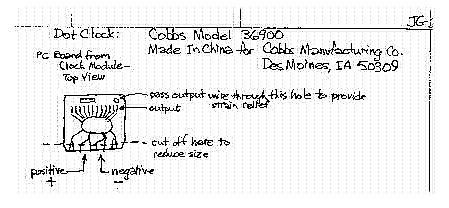
  6. Follow the drawing here in.
  7. Reassemble and reinstall.

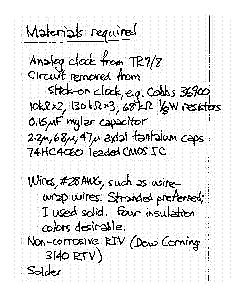
Materials required:

cobssmodel

For a complete scan of the document please fetch them at ftp://voskotan.com. Beware they are very large!!!

What if the clock is broken?
The update only works if the clock is working very well - about five times better than specified. The only failure mechanism that I have seen was a failure of the setting cable to disengage, binding the mechanism. If you have this problem, you can bend the spring that pushes on the setting knob, until it pushes hard enough to always disengage.

You will be 'fatiguing' the metal into a different shape with a higher force. I would think that, if this were proper spring steel, you couldn't do this (and wouldn't have to either).

Assembly directions page (fetch scan at ftp://voskotan.com)

material

Theory of the operation.
The clock module is meant to drive a 4-digit display with flashing (after setting) colon. The end connections to the LCD display are 'digit drive' signals.

The frequency is exactly 32Hz (within the tolerance of the 32768Hz crystal). This signal is routed to a CMOS oscillator that nominally runs at 32Hz, and is locked by injection. The analog clock is based on a sping/mass 'resonator' or 'pendulum'. If left in motion, it's motion will slowly decay while oscillating at 2,5Hz.

The circuit senses the motion of the pendulum past a coil, and kicks it with a magnetic field from a second intertwined coil. To injection lock this oscillator, the circuit divides the 32Hz reference to a sub-multiple of the 2,5Hz (0,5Hz) and kicks the coil at this rate, injection locking it.

Joe Gorin (USA)