 1133 Chatmoss Dr., Va. Beach, Va. 23464; (757) 495-8229
Originally written: circa 1989
Last update:
Jan 16, 2006 - Added pictures and reworded parts.
Now lets move on to some more specialized tools that will come in very handy for troubleshooting and diagnosing problems. These are usually be purchased as needed.
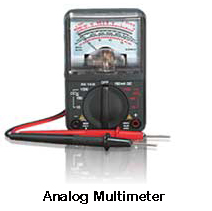 First in my book is an analogue multimeter.
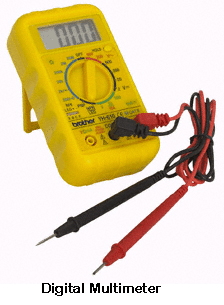 The digital ones are OK but I prefer the old fashioned ones with the real meter
movement. Probably the best source for one of these is Radio Shack. A good meter
can be purchased for about $30 on sale. This will allow you to measure voltage
(AC or DC), current, and resistance. This tool is a must for trouble
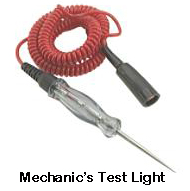
shooting any electrical problem. I know most mechanics just use the Test light
(little screwdriver looking thing with a light bulb in it, but that just doesn't cut it for me
although it is better than nothing). It is pretty much a go, no go, tool.
The digital ones are OK but I prefer the old fashioned ones with the real meter
movement. Probably the best source for one of these is Radio Shack. A good meter
can be purchased for about $30 on sale. This will allow you to measure voltage
(AC or DC), current, and resistance. This tool is a must for trouble
shooting any electrical problem. I know most mechanics just use the Test light
(little screwdriver looking thing with a light bulb in it, but that just doesn't cut it for me
although it is better than nothing). It is pretty much a go, no go, tool.
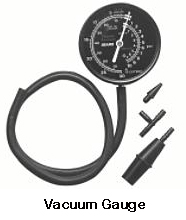
A vacuum gauge is used to measure the vacuum in the car's engine and they are great diagnostic tools. Many old timers use them for setting carbs and timing. Like a compression gauge, the vacuum gauge lets you get a feel for what is happening in the engine, like sticking valves, ignition and valve timing, or if any of the valves are burned, and more. They can also be used for checking fuel pressure on low pressure (non-fuel injected systems).
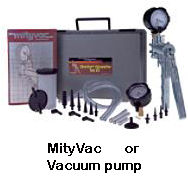
 Another vacuum related tool is the MityVAC or Vacuum Pump Kit. In addition to having a
vacuum gauge, it has a trigger grip to allow
Another vacuum related tool is the MityVAC or Vacuum Pump Kit. In addition to having a
vacuum gauge, it has a trigger grip to allow
 you to create a vacuum for testing all kinds of diaphragms, etc. as well as read
vacuum and you can see how long a part holds a vacuum. They cost from about $25 to
about $70 depending on what accessories you get with in. Many come with a great book
on how to use on in troubleshooting engine problems. The newer the car is the more
vacuum operated controls there are, like the heating system.
you to create a vacuum for testing all kinds of diaphragms, etc. as well as read
vacuum and you can see how long a part holds a vacuum. They cost from about $25 to
about $70 depending on what accessories you get with in. Many come with a great book
on how to use on in troubleshooting engine problems. The newer the car is the more
vacuum operated controls there are, like the heating system.
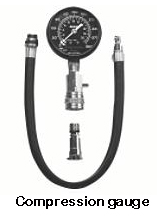
A compression gauge is used to check how much pressure can be created in a
cylinder.
A compression test, along with a vacuum gauge, is about the only way of
telling if an engine has a blown head gasket, bad valves, or rings without removing
the head. If you buy one, spend the extra money and get the one that have a long
 flex hose and actually screw into the spark plug holes instead of the inexpensive
ones you have to push on and hold. In many of the newer cars you can't get these
inexpensive ones to the spark plug holes.
flex hose and actually screw into the spark plug holes instead of the inexpensive
ones you have to push on and hold. In many of the newer cars you can't get these
inexpensive ones to the spark plug holes.
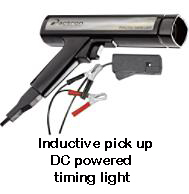
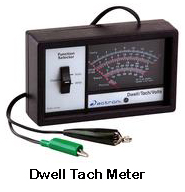
For tuning up older cars with points, (pre 1980 - Before Computers), you will need a timing light and a dwell/tach meter. I prefer the DC powered timing light (about $50). This type of timing light clips onto the cars battery to power the light, and clips onto #1 spark to pickup when #1 spark plug fires. This triggers its high intensity light which can be seen even on a sunny day. The dwell meter is used to set the points and the tachometer is used to set the engines idle speed.
 For newer cars, post 1980 you will need a code reader. The computers store information
about how the various sensors are working. When something isn't working correctly, the
computer sets a code, and turns on the Check Engine Light (CEL) or Maintenance required
Light (MIL). From 1980 to 1996 car manufacturers used a system called "On Board
Diagnostics". Manufactures were able to do as they please. For example, GM products
For newer cars, post 1980 you will need a code reader. The computers store information
about how the various sensors are working. When something isn't working correctly, the
computer sets a code, and turns on the Check Engine Light (CEL) or Maintenance required
Light (MIL). From 1980 to 1996 car manufacturers used a system called "On Board
Diagnostics". Manufactures were able to do as they please. For example, GM products
 required umpiring 2 pins on a connector under the dash, and the codes would blink out
on the CEL. For required a special tool for this (usually about $35) that exercised
the various servos and check the sensors, then it displayed the codes by blinking them
out on a light on the tool. Chrysler was user friendly, you turned the key from off to
run, than back off, and repeated this 3 times. The 3rd time, you left the key in the
required umpiring 2 pins on a connector under the dash, and the codes would blink out
on the CEL. For required a special tool for this (usually about $35) that exercised
the various servos and check the sensors, then it displayed the codes by blinking them
out on a light on the tool. Chrysler was user friendly, you turned the key from off to
run, than back off, and repeated this 3 times. The 3rd time, you left the key in the
 run position and the codes would blink out on the CEL. Volvo didn't provide any way
for a layperson to get the codes on some of their cars. In 1996 manufactures went to
"On Board Diagnostics II". This set a standard on the interface connector, and the
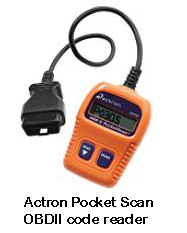
error codes, and let some codes for the manufacturer to define. A good ODB II code
reader can be purchased for about $80, like the Actron PocketScan. They only read
and output the codes on a 1 line screen and usually have provisions to reset the
codes. You will have to look up the code numbers in a book just like you have to for
run position and the codes would blink out on the CEL. Volvo didn't provide any way
for a layperson to get the codes on some of their cars. In 1996 manufactures went to
"On Board Diagnostics II". This set a standard on the interface connector, and the
error codes, and let some codes for the manufacturer to define. A good ODB II code
reader can be purchased for about $80, like the Actron PocketScan. They only read
and output the codes on a 1 line screen and usually have provisions to reset the
codes. You will have to look up the code numbers in a book just like you have to for
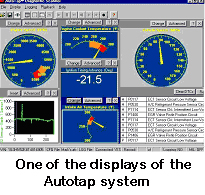 and ODB system. There are more complex scanners available (like the made by
autotap.com) that connect to a lap top computer and let you monitor a many of
the parameters real time, retrieve error codes, and reset codes. These typically
run from $300 to over $500.
and ODB system. There are more complex scanners available (like the made by
autotap.com) that connect to a lap top computer and let you monitor a many of
the parameters real time, retrieve error codes, and reset codes. These typically
run from $300 to over $500.
Moving on to some more specialized tools, inevitably you will need a couple of gear
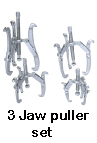
pullers (2 and or 3 jaw) for removing pulleys and gears from things. I'd suggest that
maybe you get a 3 jaw puller set. Otherwise wait until you need the puller and buy it
against the job. There are
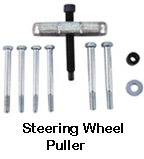
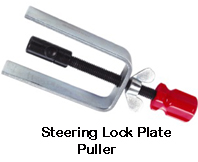
 special pullers for AC compressor clutches, Pitman arm, power steering pump pulleys,
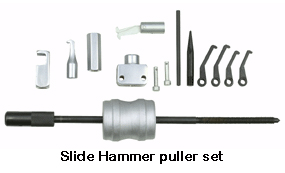
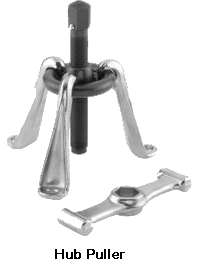
hub, axles and bearings you will need a special set of pullers. A hub puller is quite
large and it bolts to the hub. The axle puller is smaller and has a slide handle. The
puller can be reversed for pulling bearings and races. (Harbor Freight has a set for
about $33.)
special pullers for AC compressor clutches, Pitman arm, power steering pump pulleys,
hub, axles and bearings you will need a special set of pullers. A hub puller is quite
large and it bolts to the hub. The axle puller is smaller and has a slide handle. The
puller can be reversed for pulling bearings and races. (Harbor Freight has a set for
about $33.)
Now that's what I call a pretty nice tool box. Unfortunately, we have an expensive hobby and now we start filling our garage, not just the tool box, with tools. These tools will also be a little more expensive.
Now we'll go back to some tools that don't find in the tool box. An air
compressor and the associated air tools, while not necessary, are a great time
 saver and make working on car a lot easier. One of the most important jobs in
restoring a car, is fighting rust. When I restore a car, every metal part is removed,
cleaned and painted. So here again an air compressor will pay for itself. I would not
recommend anything smaller than a 4hp compressor with a 20 gallon accumulator. I grew
saver and make working on car a lot easier. One of the most important jobs in
restoring a car, is fighting rust. When I restore a car, every metal part is removed,
cleaned and painted. So here again an air compressor will pay for itself. I would not
recommend anything smaller than a 4hp compressor with a 20 gallon accumulator. I grew
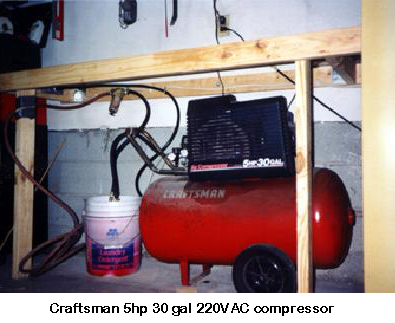
 up with one like this, my dad has had his Craftsman compressor for over 20 years. But
it has trouble keeping up with the sanders, sand blasters, etc. So when I went to
purchase mine, I went up one size, to a Craftsman 5 hp with a 30 gallon tank (it cost
about $500). The rule of thumb is the "bigger the better", but your pocket book and
up with one like this, my dad has had his Craftsman compressor for over 20 years. But
it has trouble keeping up with the sanders, sand blasters, etc. So when I went to
purchase mine, I went up one size, to a Craftsman 5 hp with a 30 gallon tank (it cost
about $500). The rule of thumb is the "bigger the better", but your pocket book and
 available space will control your spending. Compressors of less than 4hp use 115V
while the 4hp and larger use 220V. If you opt for a larger one, you might have to run
a new power line from your service panel.
available space will control your spending. Compressors of less than 4hp use 115V
while the 4hp and larger use 220V. If you opt for a larger one, you might have to run
a new power line from your service panel.
The horse power (hp) rating of the electric motor (i.e.. 5 hp., 10 hp., etc.). Lately,
the marketing departments of the various compressor manufactures have been playing
games with the hp ratings. It seems that they are rating them based on the maximum
current the motor will draw (when starting) and not the running current. So beware.
1 hp is about 750 Watts. So a 5 hp motor should consume about 5x750=3750 Watts or 3.7
Kilowatts (KW). To calculate the current required by the motor divide the Watts by the
Voltage (either 115 or 220). So a 5 hp motor will draw at least 3750/115 = 32.6 amps
on a 115V circuit, or 3750/220 = 17 amps on a 220V circuit. This assumes that the
motor is 100% efficient, which it isn't. House hold wiring usually has 2 types of
circuits - the 110V (also referred to as 115V or 120V) used for most electrical
lighting and small appliances. The maximum a 115V circuit will be rated for is about
 30 amps. Heavy appliances like an electric dryer, water heater, and stove all usually
run in a 220V circuit. So you see that a 5 hp compressor will require a 220V circuit
in your shop.
30 amps. Heavy appliances like an electric dryer, water heater, and stove all usually
run in a 220V circuit. So you see that a 5 hp compressor will require a 220V circuit
in your shop.
To help dry the air (remove moisture), you will need a dryer attached to the output of the compressor. My compressor sits by the front of the garage and I have 50' of air hose connected directly to the dryer. Originally the dryer was connected directly to the compressor and consequently could not pull any moisture out of the air. To condense the moisture out, there must be some distance between the output of the compressor and the dryer, 2 inches just didn't hack it. I got some copper tubing and wrapped it around a 2 liter Coke bottle. I connected 3 foot length of air hose to each end of the coil with one end going to the output of the compressor and the other end going to the dryer. This alone pulls a lot of water out of the air. In addition, I can submerge the coil in a bucket of water to help cool the air even more.
Next, you will need some paint guns. Since the primer is relatively thick, a pressure
feed gun is usually used. This type gun lets the compressed air into the paint tank
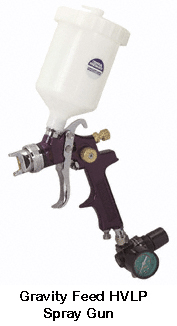 to pressurize it, thereby forcing the paint out. You can skimp on the cost of this gun
as the primer will get sanded and smoothed. My gun for priming is an inexpensive Sears
pressure/siphon gun (found at a yard sale for $5). For painting the top (color) coats
a siphon feed gun is used. These guns let the air blow past the pickup tube,
creating a vacuum and sucking or siphoning up the paint. These guns are more expensive;
mine is a SEARS and cost about $70. A professional gun like a Binks can start at about $150.
Relatively recently a new type of gun has hit the market, a High Volume Low Pressure
(HVLP). These guns are supposed to reduce over spray, and put more paint on the surface.
I got a Harbor Freight one a couple of years ago for Christmas. I've used it quite a bit,
and I like it better than any of the other spray guns I have.
to pressurize it, thereby forcing the paint out. You can skimp on the cost of this gun
as the primer will get sanded and smoothed. My gun for priming is an inexpensive Sears
pressure/siphon gun (found at a yard sale for $5). For painting the top (color) coats
a siphon feed gun is used. These guns let the air blow past the pickup tube,
creating a vacuum and sucking or siphoning up the paint. These guns are more expensive;
mine is a SEARS and cost about $70. A professional gun like a Binks can start at about $150.
Relatively recently a new type of gun has hit the market, a High Volume Low Pressure
(HVLP). These guns are supposed to reduce over spray, and put more paint on the surface.
I got a Harbor Freight one a couple of years ago for Christmas. I've used it quite a bit,
and I like it better than any of the other spray guns I have.
There is also the Powder coating systems. However, for these you need an oven to cook the parts in after they have been sprayed.
Now that you have a compressor, you have an excuse to get some of those nice air tools
you've been looking at, like a 1/2" drive impact wrench (from $40 up). This
really makes changing tires easy and reduces the busted knuckles when trying to undo a
really rusted bolt. (Note, I purchased a 2nd 1/2" impact wrench. It's a Champbell
Hausfeld Professional PL1502 for about $65 from Northern Hydraulics. It has
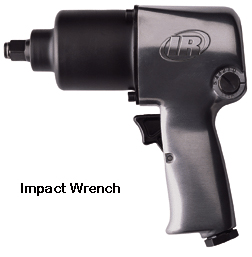 about twice the umph of my $30 wrench. I love it, it has replaced my cheap impact wrench
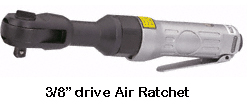
as my work horse.). Another great air tool is a 3/8 drive ratchet (about $30), and
I don't know how I ever lived without it. No more hand cranking on the ratchet, just press
the trigger and it does all the work! One word of caution though, Don't use it to
break nuts and bolts loose. If you do, you will drastically reduce its life span. I broke
the gears on my first one, trying to break a bolt loose. Use either an impact wrench or a
manual ratchet to break bolts loose. Also, DO NOT use an impact wrench or air ratchet
about twice the umph of my $30 wrench. I love it, it has replaced my cheap impact wrench
as my work horse.). Another great air tool is a 3/8 drive ratchet (about $30), and
I don't know how I ever lived without it. No more hand cranking on the ratchet, just press
the trigger and it does all the work! One word of caution though, Don't use it to
break nuts and bolts loose. If you do, you will drastically reduce its life span. I broke
the gears on my first one, trying to break a bolt loose. Use either an impact wrench or a
manual ratchet to break bolts loose. Also, DO NOT use an impact wrench or air ratchet
 to fully tighten nuts and bolts. They give no feed back or feel and it is easy to break
bolts off with them. If using to run the nut or bolt down, always set the tool to its lowest
power setting and stop when the impact wrench start to make the familiar banging sound, or the
air ratchet starts to pull in you hand. Then switch to a regular ratchet or torque wrench to
finish the job.
to fully tighten nuts and bolts. They give no feed back or feel and it is easy to break
bolts off with them. If using to run the nut or bolt down, always set the tool to its lowest
power setting and stop when the impact wrench start to make the familiar banging sound, or the
air ratchet starts to pull in you hand. Then switch to a regular ratchet or torque wrench to
finish the job.
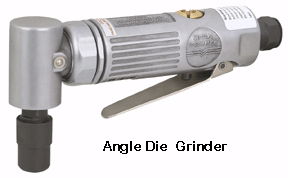
A 1/4" die grinder ($25) is a high speed tool and comes in straight and angled. I bought an angled grinder and an arbor and a cutting wheel. This makes short work for cutting off bolts and such. It can also be used to cut sheet metal - like a section from a fender. There is also a rubber disked arbor that you can attach a 3" sanding pad for it and some stick on 80 grit sandpaper. There are also various cutting burrs and grinding stones.
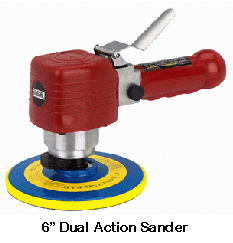
 For doing body work a dual action "DA" sander (about $40) and an inline sanders
(about $40) are real time savers.
For doing body work a dual action "DA" sander (about $40) and an inline sanders
(about $40) are real time savers.
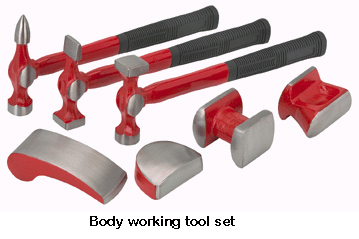
Speaking of body work, Harbor Freight has a nice set of body hammers and dollies for under $20.
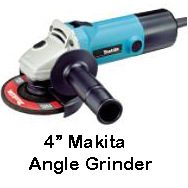
For cleaning paint and rust off of metal parts I use a 4"
high speed (10,000 rpm) grinder (from $40 to $100). The
grinding stone can be removed and replaced with a knotted wire brush.
Unfortunately, these brushes are pretty expensive (about $15 each) they are
 the only ones rated to handle the 10,000 + rpm's of the grinder. For
relatively large areas, this high speed wire wheel does a better job than
paint stripper. I purchased an inexpensive one for $40 from Harbor
Freight. My dad borrowed and loved it, so he bought a Makita for $55.
However, we both like the one from Harbor Freight better. The 2 drawbacks
to the Makita are, 1 - the arbor size is metric M10x1.25. Most discount
houses sell the standard 5/8" x 11 brushes but very few handle the
M10x1.25. Consequently, getting the wire wheels is harder and more
expensive. The second problem is the Makita's safety guard is screwed to
the case and cannot be rotated. Many times we wanted to move the guard
the only ones rated to handle the 10,000 + rpm's of the grinder. For
relatively large areas, this high speed wire wheel does a better job than
paint stripper. I purchased an inexpensive one for $40 from Harbor
Freight. My dad borrowed and loved it, so he bought a Makita for $55.
However, we both like the one from Harbor Freight better. The 2 drawbacks
to the Makita are, 1 - the arbor size is metric M10x1.25. Most discount
houses sell the standard 5/8" x 11 brushes but very few handle the
M10x1.25. Consequently, getting the wire wheels is harder and more
expensive. The second problem is the Makita's safety guard is screwed to
the case and cannot be rotated. Many times we wanted to move the guard
 around to allow better access when cleaning a part. When using these
grinders, you should wear some sort of eye protection. I've purchased a
face shield for about $12 from Northern Hydraulics. Since I wear glasses,
goggles tend to fog up. You should also use some kind of hearing
protector. I bought a pair of "Mickey mouse" ears from Northern Hydraulics
for about $8. Finally, you should wear a pair of leather gloves. I've had
the wire wheel get away from me and nick my hands. It took forever to
heal, and left some nice scars.
around to allow better access when cleaning a part. When using these
grinders, you should wear some sort of eye protection. I've purchased a
face shield for about $12 from Northern Hydraulics. Since I wear glasses,
goggles tend to fog up. You should also use some kind of hearing
protector. I bought a pair of "Mickey mouse" ears from Northern Hydraulics
for about $8. Finally, you should wear a pair of leather gloves. I've had
the wire wheel get away from me and nick my hands. It took forever to
heal, and left some nice scars.
In addition to the high speed grinder, the 3/8" (VSR) electric drill can be use to clean parts by chucking up a wire wheel. The wire wheels are about $5 and an arbor to hold the wheel is about $2.
For small parts or places that the grinder can not get to, a
sandblaster is great! I started with a siphon blaster with a 50
 pound sand tank (from $50 to $100). I moved up to a Harbor Blast Cabinet
and to a pressure blaster. For more information check out my article on
media blasting.
pound sand tank (from $50 to $100). I moved up to a Harbor Blast Cabinet
and to a pressure blaster. For more information check out my article on
media blasting.
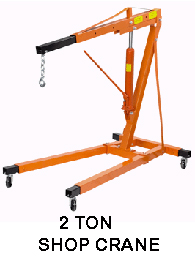
If you plan on doing any major work like pulling an engine or pulling a body
off a chassis, an engine crane is a must. I purchased mine, a 2 ton
hoist, for about $200. While these can be rented, I figured I had to pull and
 replace the engine and the body of my Morgan, and pull and replace the engine
and body of my '75 Bricklin. At about $35 per day rent, I could just about
purchase one for the rental fee, so I did and been saving money ever since. To
cut down on the space it requires, when not in use, I disassemble mine and tie
all the parts against the wall of my garage.
replace the engine and the body of my Morgan, and pull and replace the engine
and body of my '75 Bricklin. At about $35 per day rent, I could just about
purchase one for the rental fee, so I did and been saving money ever since. To
cut down on the space it requires, when not in use, I disassemble mine and tie
all the parts against the wall of my garage.
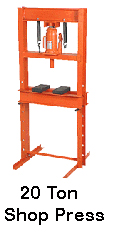
A hydraulic press is a useful item although expensive. While you can send the work out to be done, unless you know someone, it can get expensive. Depending on the type of work you are doing, this will be one of the least used tools in your shop. You use them to press on or off Universal Joints, bushings, and bearings. I had to pay $30 to have the old bearings pressed off and a new bearing pressed into the steering knuckle of my Voyager van. Since I've got 2 Voyagers and had to do the job to both, that's 4 times. Almost the cost of a press. However, it's nice to be able to press bearings on and off when you need to. Harbor Freight as several nice presses for about $120 - $220.
Another item is a welder. There are 3 basic types of welders:
oxy-acetylene, arc, and MIG or wire feed. While the MIG (or wire
feed) welder is the most expensive of the 3. MIG stands for welding for
dummies! Not really it stands for Metal Inert Gas. I would suggest a MIG
welder for an initial investment. But is the easiest to learn to use. Most
 welding on a car is replacing thin sheet metal panels. This is what the
MIG does best. The MIG welder doesn't generate the heat the other 2 welders
do. The wire feed feature makes welding easier for the hobbyist use. I'm
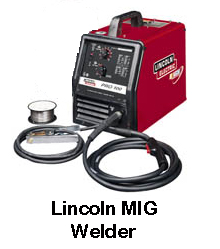
purchased a Lincoln SP100 MIG welder for about $600. To add the gas
regulator, bottle, hood and gloves cost about $200 more. The MIG and the
wire-feed welders are the same unit. The difference is for MIG you add the
gas regulator and bottle of gas. There is a different sleeve that goes
inside the cable that feeds the wire also to handle the different size
diameter of the welding wire. The MIG wire is about .023" while the gas
less wire is has flux in it core and is about .035". If you decide to purchase
a MIG welder, look for one that has continuously variable wire feed speed and
voltage settings vise the 4 to 6 click stop settings. This way, you can adjust
the machine to fit you and you don't have to learn vary your welding to meet the
machine.
welding on a car is replacing thin sheet metal panels. This is what the
MIG does best. The MIG welder doesn't generate the heat the other 2 welders
do. The wire feed feature makes welding easier for the hobbyist use. I'm
purchased a Lincoln SP100 MIG welder for about $600. To add the gas
regulator, bottle, hood and gloves cost about $200 more. The MIG and the
wire-feed welders are the same unit. The difference is for MIG you add the
gas regulator and bottle of gas. There is a different sleeve that goes
inside the cable that feeds the wire also to handle the different size
diameter of the welding wire. The MIG wire is about .023" while the gas
less wire is has flux in it core and is about .035". If you decide to purchase
a MIG welder, look for one that has continuously variable wire feed speed and
voltage settings vise the 4 to 6 click stop settings. This way, you can adjust
the machine to fit you and you don't have to learn vary your welding to meet the
machine.
I must admit that my dad already has the oxy-acetylene (with the 5 foot tall tanks) and an arc welder so I have access to them and haven't had to buy either of these. Taking a quick look at oxy-acetylene welders. What are they good for? A very good welder can weld about anything with one of these units, but it takes a long time to become that good. Due to the heat generated, it is very ease to warp a thin sheet metal panel on a car. The other two things that are nice about oxy-acetylene welders, is the heat and cutting. If you need to bend or shape a piece of metal, you can get it cherry hot and then bend or shape it a lot easier than doing it cold. Another nice thing about the heat, is if you have a nut or bolt that doesn't want to move, in many cases you can use the "hot wrench" technique. Get the nut or the metal surrounding the bolt hot. This heat will help loosen the nut or bolt. Finally, there is the cutting torch aspect. While the cuts aren't the smoothest it does cut metal nicely and quickly. I find that many times I need to cut up something, like a car that my friends and I are stripping. To move my dad's 5 foot tanks from his place to mine is a real chore, and to move some of the things I'm working on to his place is even harder. Consequently, I'd prefer a slightly smaller set of bottles. Something in the neighborhood of 40 to 60 cubic feet. This setup has the advantage of portability. The only drawback is that the bottles of gas don't last as long. It's a real pain to run out of gas on a Friday night and not be able to use the equipment until Monday night after the welding suppliers open Monday. One final note on oxy-acetylene, if you get a setup, be sure to get flame arrestors. These connect to the hoses, and are designed to keep the flame from walking back into the lines and causing the tanks to explode. Welding can be very useful, but like a lot of tools (especially electric saws) it can be very dangerous. Look around where you are going to weld. You don't want anything that is flammable near by. If you are a home hobbyist, try to do all you welding and cutting outside. You don't want the sparks to catch something on fire in your garage. Also be careful when welding on a car. Again, look at what you plan on welding, both sided. Don't try to weld on the bottom of the floor pans, and still have the seats, carpet, or insulation material in place. They will catch on fire. If you decide to purchase any type of welder, check with your local Vocational Technical Schools, or Community Colleges. Many offer welding courses. These are definately worth the cost. You will got through a lot of gas, electricity, and metal learning to weld. All this is covered in the cost of the class. Plus you have an instructor to help you with the technique.
In closing, the tools just mentioned represent quite a sizable investment and will start to set up a very nice work shop. You may not need or want all the tools I've described here. But you now have an idea of some of the tools that are available and what they are used for. You don't have to go out and purchase all the tools at once. Keep a list of desired tools prominently displayed or just hand it the your wife, girl friend and kids (or all three). There is always a tool for every gift giving occasion.
If you aren't already familiar with the companies I've mentioned, here are the names of several mail order tool houses. If you don't have their catalogues, simply give them a call and they'll send you one. They make great reading. You can spend hours just drooling over all the tools you don't have and dream of how much easier life would be if you only had that tool.
Enjoy your Car
John
Harbor Freight Tools
3491 Mission Oaks Blvd
P.O. Box 6010
Camarillo, Ca. 93011-6010
(800) 423-2567 - They have a wide range of items from shop
rags to milling machines.
Kitts Industrial Tools
22384 Grand River Ave.
Detroit, Mi. 48219
(800) 521-6579 - They have a wide range of items.
Sears Tool catalogue, Can be picked up at most Sears stores.
Return to the Index of Tech. articles
To email me with comments or questions.